
Railway monitoring
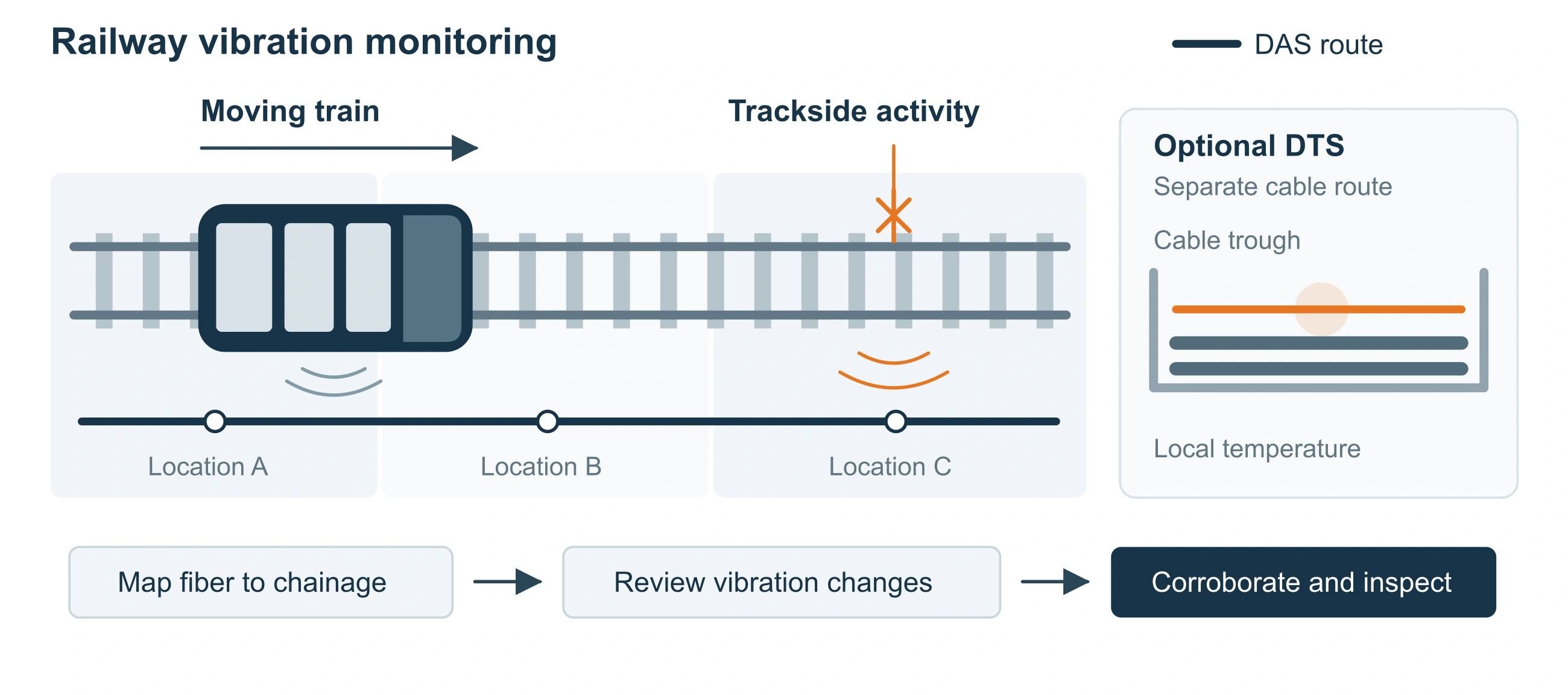
Planck distributed acoustic sensing (DAS) measures vibration along an optical fiber. A track-parallel sensing route provides observations that can be mapped to railway chainage for operational review and maintenance.
Train and trackside activity
Passing trains and nearby work create vibration patterns along the route. With suitable fiber coupling and validated processing, these observations can support train movement awareness and locate trackside activity for investigation.
Vibration records for inspection
Comparing repeatable patterns between train passages can help identify changes for engineering review. Train type, speed, adjacent tracks and ground conditions affect the comparison. Suspected wheel or rail defects require confirmation through dedicated analysis and inspection.
Route assessment
Assess fiber availability, optical loss and coupling before selecting equipment. Map fiber distance to chainage and asset records. A pilot establishes normal activity and tests representative events, including adjacent-track traffic and maintenance work. Some locations may need a dedicated sensing cable.
Cable and tunnel temperature
DTS provides a separate temperature profile along traction-power cables, cable troughs and tunnel services. It helps locate unusual heating where sensing cable placement provides suitable thermal contact. Conductor temperature or cable loading estimates require an appropriate thermal model.
Supplementary monitoring does not replace railway signaling, protection or safety inspection.
Planck DAS equipment
Planck DAS systems use single-mode fiber with FC/APC connectors. REST API, WebSocket and Ethernet support project-specific data integration. DTS equipment is selected separately for thermal monitoring.
View DAS equipment| Variant | Max. range | Spatial resolution |
|---|---|---|
| 20 km single-mode | 20 km | 1–10 m |
| 40 km single-mode | 40 km | 5–10 m |
Select range and spatial resolution together with measurement settings. Confirm performance in the model datasheet.
Discuss your project
Send the route length, fiber details and inspection priorities to discuss a railway pilot.