
Pipeline monitoring
Planck fiber sensing measures vibration and temperature along instrumented pipeline routes. Distributed observations help operators locate changes and focus investigation alongside existing pipeline instrumentation.
Activity near the pipeline
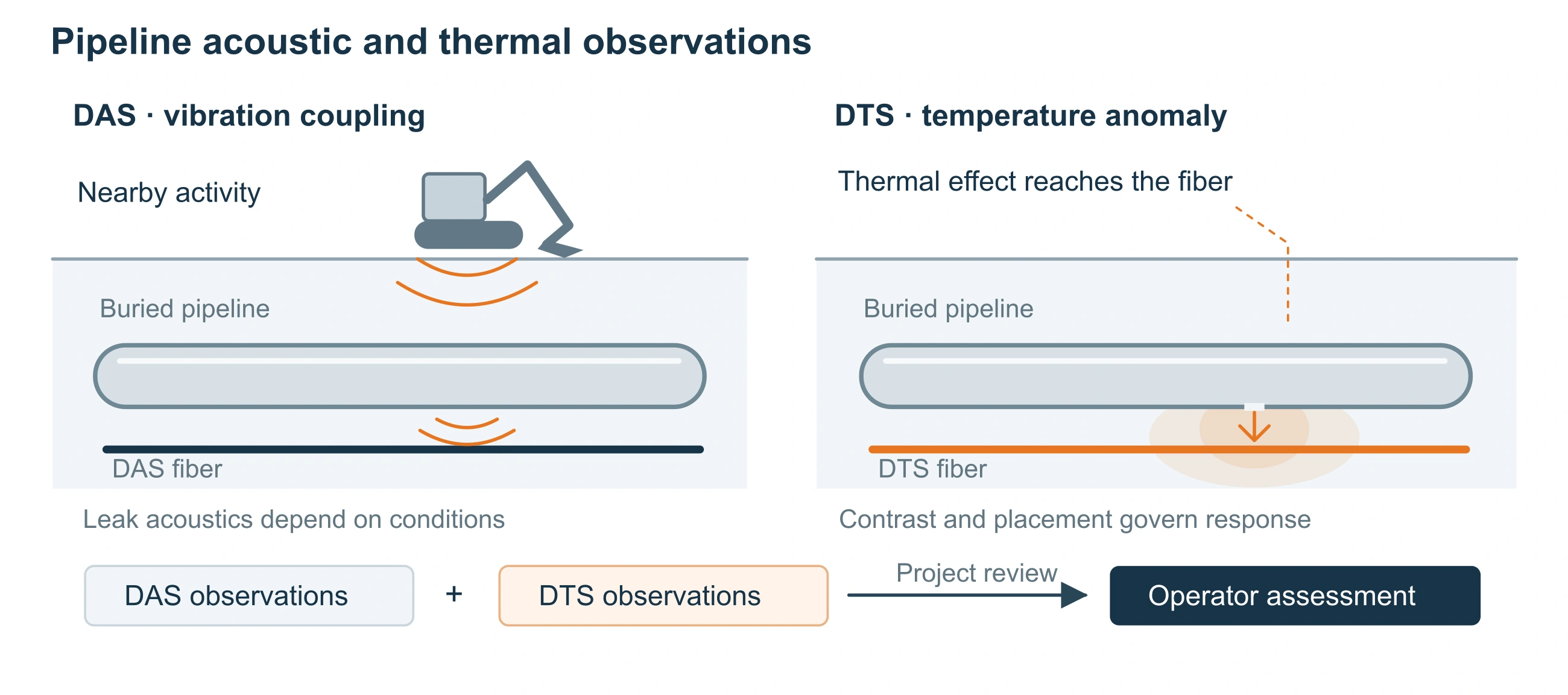
Distributed acoustic sensing (DAS) records vibration reaching a coupled fiber. Excavation, impacts and vehicle movement can produce observable events. Burial, ground conditions, cable placement and background activity determine the response.
Leak-related observations
DAS may observe vibration from a pressurized release under suitable flow and coupling conditions. Distributed temperature sensing (DTS) can reveal thermal changes when a leak creates sufficient contrast and heat transfer reaches the cable. Neither method detects every leak.
Sensing cable placement
Review pipeline geometry, fluid conditions and the available fiber route. Assess cable condition, proximity and protection before choosing existing fiber or a dedicated cable. A route suited to observing construction activity may not capture a thermal leak effect.
Operator review
Map observations to pipeline chainage, crossings and access points. Compare events with normal operating behavior and other instrumentation before deciding on inspection or response. Alarm criteria and event interpretation are developed for the installation.
Planck DAS equipment
Planck DAS systems use single-mode fiber with FC/APC connectors. REST API, WebSocket and Ethernet support project-specific data integration. DTS equipment is selected separately where temperature monitoring is required.
View DAS equipment| Variant | Max. range | Spatial resolution |
|---|---|---|
| 20 km single-mode | 20 km | 1–10 m |
| 40 km single-mode | 40 km | 5–10 m |
Select range and spatial resolution together with measurement settings. Confirm performance in the model datasheet.
Discuss your project
Send the pipeline route, operating conditions and fiber details to discuss a feasibility assessment.