
Power cable temperature monitoring
Planck distributed temperature sensing (DTS) measures temperature along a sensing fiber installed with power cables. The temperature profile helps operators locate hot sections and review changes over time.
Applications
- Underground transmission and distribution cables
- Cable tunnels and utility corridors
- Wind farm and renewable grid connections
- Landfalls and submarine cables with compatible sensing fiber
Temperature measurement
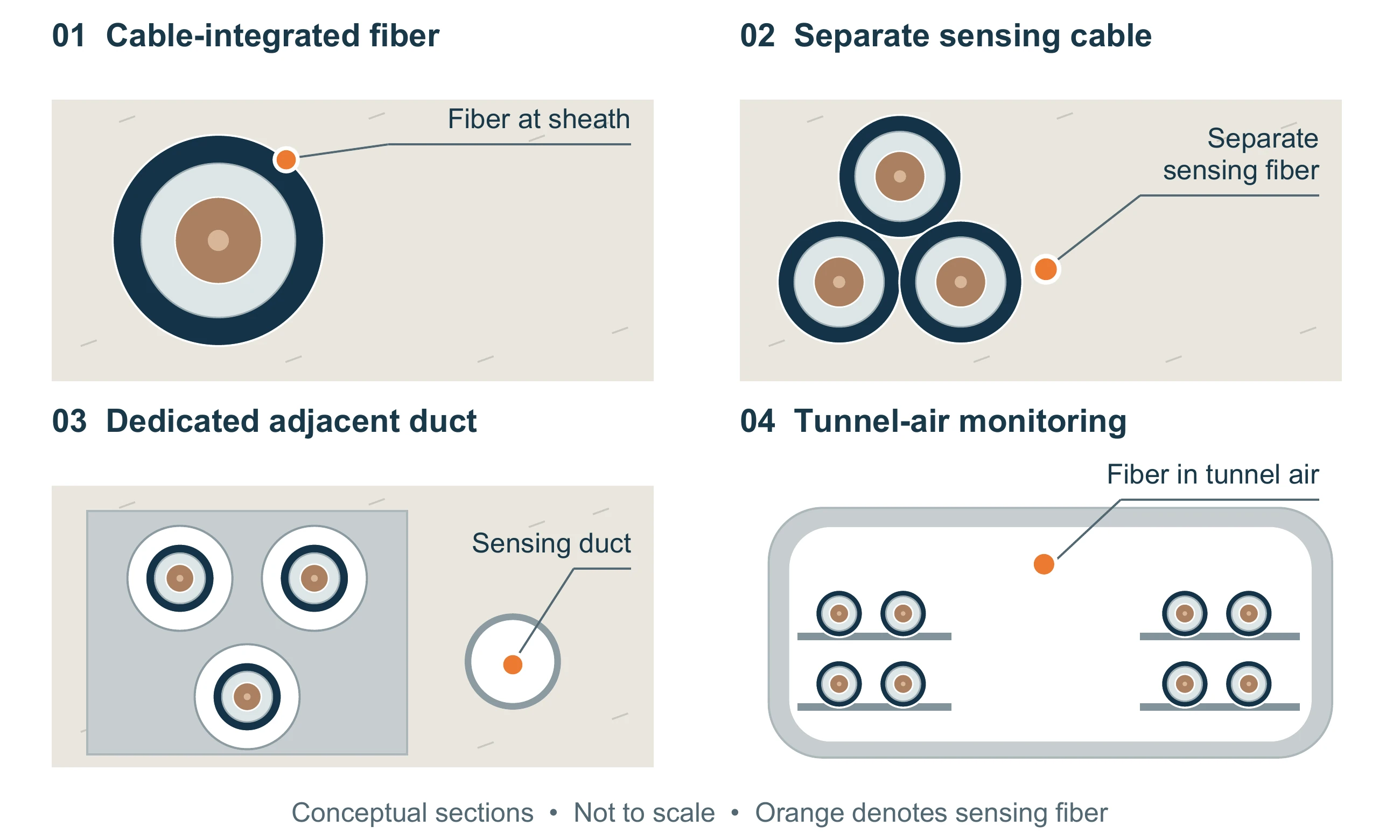
A sensing fiber runs within the cable, alongside it, or in a nearby duct. DTS reports temperature by distance. Route mapping connects measurements to cable sections, joints and crossings.
Temperature profiles, zone alarms and historical records support investigation of abnormal heating. Fiber placement and thermal contact affect the measured temperature and response time.
DTS measures at the fiber. Conductor temperature and thermal rating require a validated cable model. DTS does not replace electrical protection.
Planck DTS equipment
Four optically switched channels with E2000 connectors. Integration options include REST API, WebSocket, RS485 Modbus, Ethernet and alarm relays.
Select the model for the route length, available fiber and required spatial resolution. Confirm measurement time and accuracy in the model datasheet.
| Model and datasheet | Max. range | Spatial resolution |
|---|---|---|
| 5 km multimode | 5 km | 0.3 m |
| 10 km multimode | 10 km | 1 m |
| 15 km multimode | 15 km | 1 m |
| 25 km single-mode | 25 km | 5 m |
Spatial resolution is distinct from sampling interval. Final performance depends on the selected configuration.
Discuss your project
Send us the cable route, fiber details and monitoring requirements. We can help select the DTS configuration and sensing-fiber arrangement.