
Perimeter security
Planck distributed acoustic sensing (DAS) measures disturbances along an optical fiber. A fence-mounted or buried sensing route can help locate activity for review by the security team.
Fence-mounted sensing
Fiber secured to a fence responds to motion transmitted through the structure. Climbing, cutting and impacts can create observable disturbances. Fence construction, attachment and the condition of panels and gates affect the signal.
Buried sensing
A buried fiber responds to ground vibration from nearby movement. Cable depth, soil, surface construction and coupling affect what can be observed.
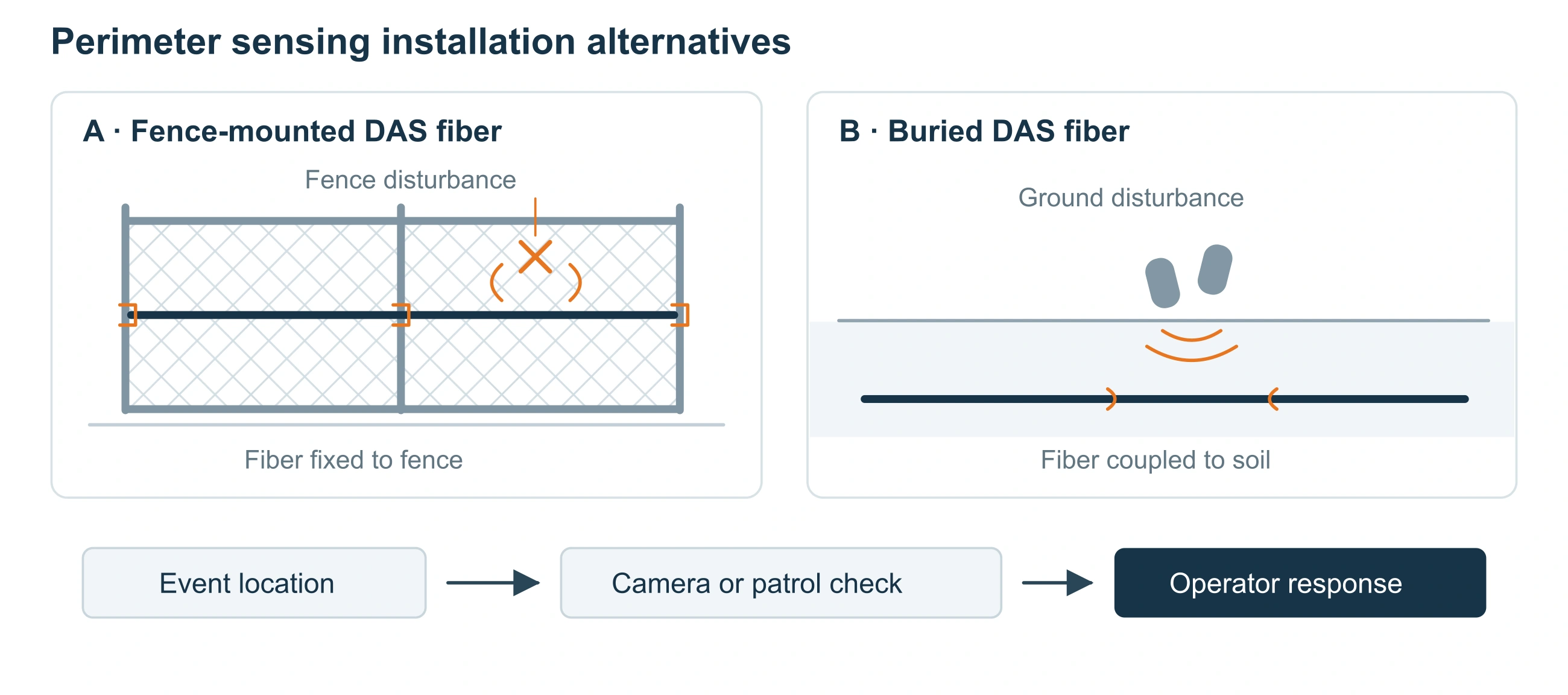
From location to verification
Map fiber distance to fence sections, gates and access roads. A monitoring workflow can associate a disturbance with the relevant camera view or patrol location. The operator uses camera or patrol evidence to determine the cause of the event and follows the site's response procedure.
Site commissioning
Survey the perimeter and assess existing fiber or a dedicated sensing cable. Record normal conditions before setting event criteria. Include wind, rain, vegetation, traffic and routine maintenance in trials, alongside the agreed test events. Review settings when the site or fence changes.
Fiber sensing supports a wider security design that includes verification, physical barriers and a response plan.
Planck DAS equipment
Planck DAS systems use single-mode fiber with FC/APC connectors. REST API, WebSocket and Ethernet provide interfaces for project-specific alarm and security-system integration.
View DAS equipment| Variant | Max. range | Spatial resolution |
|---|---|---|
| 20 km single-mode | 20 km | 1–10 m |
| 40 km single-mode | 40 km | 5–10 m |
Select range and spatial resolution together with measurement settings. Confirm performance in the model datasheet.
Discuss your project
Send the perimeter layout, fence details and response requirements to discuss a sensing trial.