
Distributed acoustic sensing (DAS) measures vibration along optical fiber. A railway assessment starts with the installed fiber and the operational question. A route that captures passing trains clearly may provide limited information about an access area farther from the cable. Before selecting equipment or defining event rules, establish where vibration reaches the fiber, how measurement locations relate to railway assets, and what an operator should do with an observation.
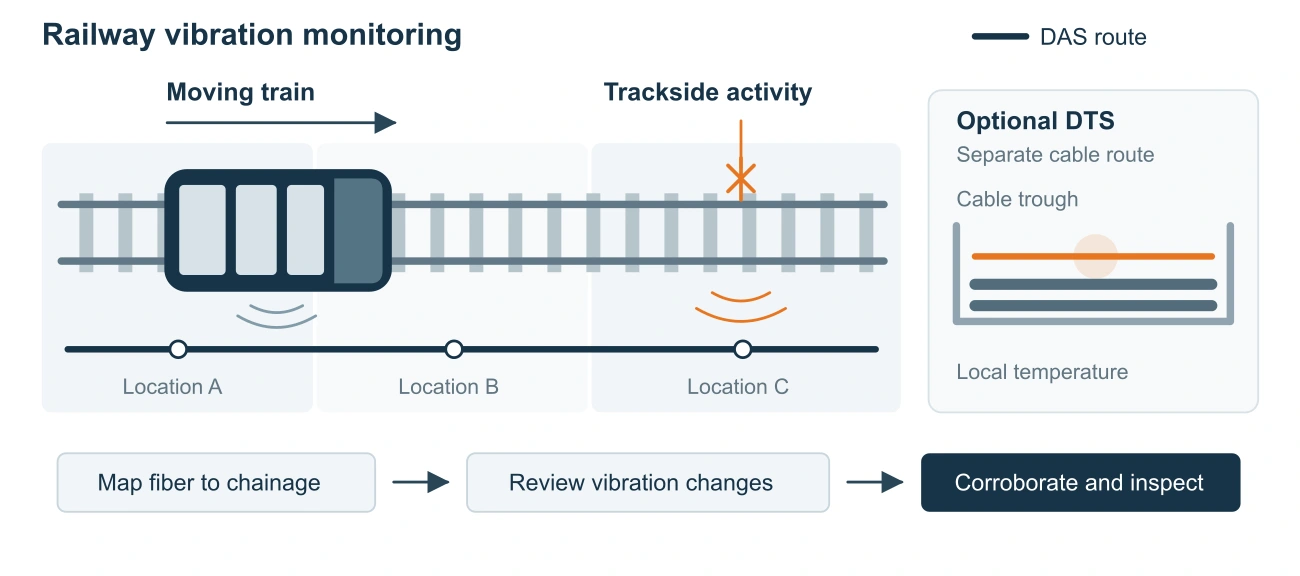
Map fiber distance to railway chainage
Distance reported along an optical fiber is not automatically railway chainage. Cable slack, diversions through equipment rooms and changes of route can separate the two. Build a mapping from fiber distance to surveyed locations, track references and asset records. Include joints, crossings, access points and sections where the cable leaves the railway alignment.
Check the mapping using events at known locations under controlled conditions. Record the confidence and any unresolved offsets. An event report should identify a useful inspection area without suggesting greater location certainty than the mapping supports.
Check the optical path and mechanical coupling
Confirm fiber availability, access arrangements, continuity, connector compatibility and optical loss. These checks establish whether the proposed optical path is suitable for the selected interrogator. A fiber that carries communications successfully still needs assessment for the sensing application.
Mechanical coupling requires a separate check. Cable construction, installation within a trough, distance from the track and the surrounding ground affect vibration transfer. Observe representative sections during train passages and agreed local tests. Document weak or inconsistent sections; some may need a dedicated sensing cable or an explicit coverage exclusion.
Separate movement awareness from trackside activity
Define train movement and trackside activity as distinct monitoring questions. Passing trains produce moving vibration patterns, while work near a fixed asset may create activity concentrated around one location. A pilot needs examples of both, with records that establish what actually happened.
Include adjacent-track traffic, shunting, stopping trains and scheduled maintenance. These conditions can complicate interpretation. A vibration event does not establish that a person is trespassing, and a stationary train may not produce a usable movement signal. Agree how ambiguous observations will be reviewed.
Compare vibration under known conditions
A change between recordings can arise from a different train or operating condition. Record train type, direction and speed where available, and account for adjacent traffic, track condition, ground conditions and recent maintenance before comparing patterns.
Use comparable passages to establish a baseline, then investigate persistent changes with independent inspection or measurements. Preserve enough context to explain the comparison. Use pattern differences to prioritize engineering review, with wheel or rail defects confirmed through dedicated diagnostic methods.
Agree pilot acceptance and temperature-monitoring needs
Agree pilot acceptance before collecting data: the events to observe, locations to verify, representative conditions and review procedure. Evaluate missed events alongside unwanted alerts. Review results with the railway team, identify exclusions and decide which applications justify wider testing. Specify the data interfaces, event records and location information the railway team needs for review.
DTS is a separate thermal application for traction-power cables, cable troughs or tunnel services. Its cable placement must allow heat from the intended asset to reach the sensor. Measured fiber temperature should remain distinguishable from conductor temperature or loading estimates derived through a thermal model.
This approach provides supplementary monitoring. It does not replace railway signaling, protection or safety inspection. Safety-related railway and fire functions require their own specified design and validation.
Explore the railway application or download the railway application brochure.