
Selecting a fiber route for a pipeline starts with the physical change that must reach the cable. A route that records construction machinery clearly may provide little thermal evidence of a leak. Planck DAS and DTS measure different effects, so a monitoring proposal should describe the installation and acceptance conditions for each measurement.
Separate activity from leak evidence
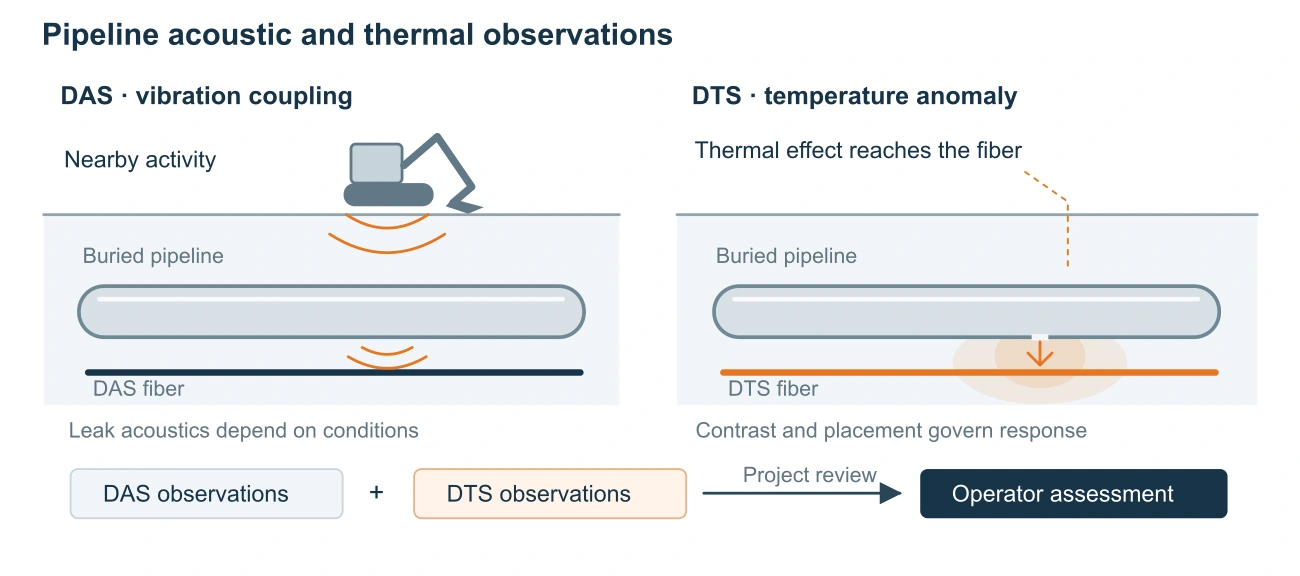
Distributed acoustic sensing records vibration reaching a coupled fiber. Excavation, impacts and vehicle movement can produce observations along the corridor. These events describe activity near the sensing route; they do not, by themselves, establish damage to the pipe.
A pressurized release may also generate observable vibration, but its acoustic response depends on the operating conditions and the transmission path to the fiber. Distributed temperature sensing observes a different effect: temperature change at the sensing cable. A leak must produce sufficient thermal contrast, and that effect must reach the cable. Neither method detects every leak.
Specify coupling and thermal exposure
Review the pipe geometry, operating states, burial conditions and available fiber route before selecting equipment. Record the cable’s position relative to the pipe, its construction and any protection or ducting. Check whether an existing fiber is suitable for the intended measurement or whether a dedicated cable is needed.
For DAS, the practical question is how vibration reaches the installed cable. For DTS, it is whether the cable experiences the thermal change of interest. A design review should address both questions explicitly. Assess thermal exposure independently, including when reusing a route that already captures corridor activity.
Map fiber distance to usable locations
Operators need a location they can investigate. Relate sensing distance to pipeline chainage, crossings, access points and the actual cable route. Include cable diversions and slack sections in the mapping record instead of treating fiber distance as a direct geographic coordinate.
Check the mapping at known locations during commissioning. Record the observed sensing position, the corresponding asset location and the reference used to connect them. The handover should give an operator enough information to select the relevant route section and direct an inspection without reconstructing the installation from raw distance data.
Test an agreed set of operating states
An acceptance plan should distinguish activity trials from the assessment of leak scenarios. Machinery tests can establish the response to nearby work; they do not validate thermal leak detection. For leak assessment, define the release mechanism, fluid conditions and how well the proposed test or model represents the installation.
Use a brief acceptance checklist:
- Confirm location mapping at agreed points along the route.
- Record representative nearby activity and normal operating periods.
- Assess the relevant leak scenarios across expected operating states.
- Check event presentation, data interfaces and operator review procedures.
Record weak or ambiguous responses as part of the acceptance result. They help define where further investigation or a different cable arrangement is needed.
Make review part of handover
Agree how observations will be compared with normal pipeline behavior and other available instrumentation. Define who reviews a change, what information accompanies it and how the decision to inspect is recorded. Set alarm criteria for the installation and validate the selected event-processing software against the agreed site tests.
Retain the route map, test conditions and accepted settings with the project records. These give later reviewers a basis for deciding whether a change in the pipeline, cable installation or operating regime calls for renewed testing.
Explore the pipeline monitoring application and download the pipeline application brochure.