
Distributed acoustic sensing (DAS) measures vibration along optical fiber. A perimeter project needs to connect an observed disturbance with a useful location and a workable security response. Cable installation determines what reaches the fiber; commissioning establishes how those observations should be handled at the site. Fence-mounted and buried routes therefore need their own installation assessment and representative trials.
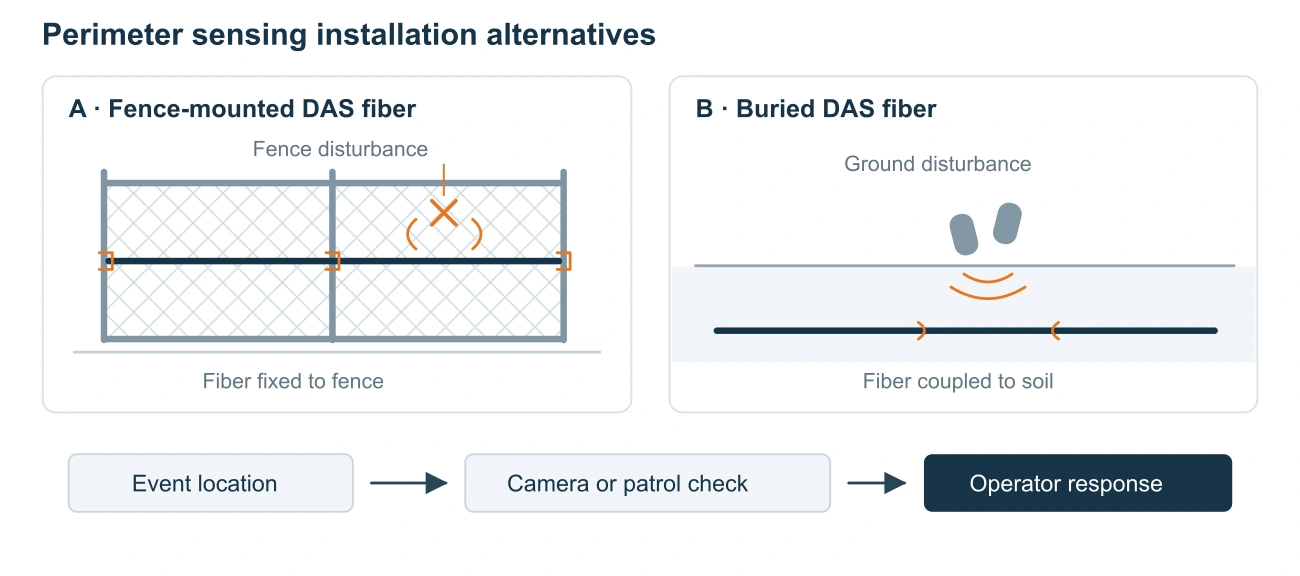
Choose the physical coupling
Fiber secured to a fence responds to motion transmitted through the structure. Panel construction, attachment points, gates and the condition of the fence affect that response. The installation survey should record these differences so that trials cover the structures the operator will actually monitor.
A buried fiber responds to ground vibration. Soil, cable depth, surface construction and mechanical coupling influence what can be observed. Assess that route separately from the fence installation. Evidence from a disturbance applied to a fence panel does not establish the response of a cable beneath a nearby road or landscaped area.
Divide the route around verification
Map sensing distance to named fence sections, gates, access roads and patrol locations. Choose zone boundaries that help the security team find and check an event. A useful zone record should identify its physical extent and the camera view or patrol reference available for verification.
Test this relationship during commissioning: generate an agreed disturbance at a known location, check the reported section and confirm that the operator can find the corresponding view or access point. The operator uses camera or patrol evidence to establish the cause of the disturbance and choose a response under the site’s security procedures.
Record nuisance conditions before setting criteria
Normal perimeter activity is part of the commissioning evidence. Include wind, rain, vegetation, adjacent traffic and routine maintenance in the assessment. Record the location and conditions alongside the sensing data so reviewers can distinguish an unexplained observation from a known site activity.
Avoid setting event criteria from a quiet demonstration alone. Review the agreed test events alongside representative normal conditions, including areas where the responses are ambiguous. Where a condition has not been observed during commissioning, record that gap and define how it will be assessed later. An untested condition should remain visible in the handover record.
Commission with repeatable events
Agree the test events and their physical locations before evaluating the installation. Keep a record of what happened, when it happened and which section was involved. Repeat relevant tests where the fence construction, ground or mounting arrangement changes, and compare the observations with the independent test record.
A practical commissioning checklist includes:
- Check sensing-distance mapping against known perimeter locations.
- Test agreed disturbances on representative installed sections.
- Review nuisance conditions and ambiguous observations.
- Confirm camera or patrol verification and operator response handling.
Define acceptance criteria for the installed system, including coverage, location checks and nuisance alarms. Where event classification is required, validate the selected analytics against the agreed site events and nuisance conditions.
Keep settings tied to the site
Retain the zone map, installation details, test records and accepted settings together. When a fence panel, gate, cable attachment or nearby ground arrangement changes, review which part of the original acceptance evidence still applies. Test the affected section again where necessary.
Planck DAS provides measurements and interfaces for project-specific integration. The complete perimeter workflow also needs physical barriers, verification and a response plan. Assign an owner for reviewing events and maintaining the configuration so that the sensing installation remains connected to the way the security team operates.
Explore the perimeter security application and download the perimeter application brochure.